
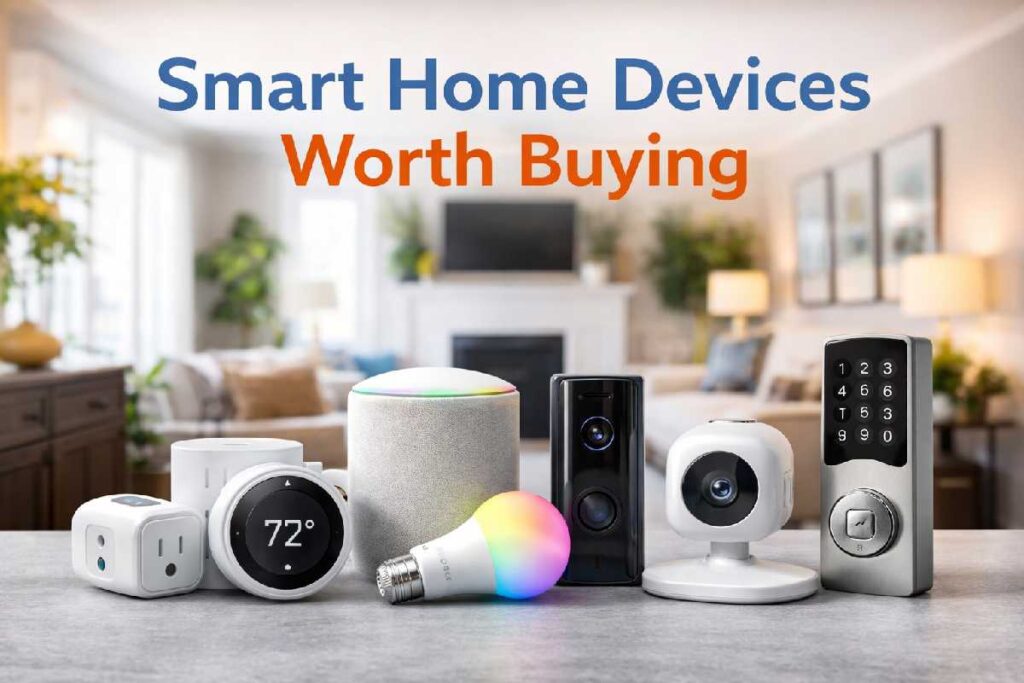
If you’ve ever looked up smart home gadgets online, you’ve probably seen everything from smart plugs and video doorbells to Wi-Fi kettles and app-controlled air fryers.
That’s the problem.
There are too many devices, and not all of them are worth paying for.
Some smart home products genuinely make life easier. Others are just expensive tech clutter that sounds cool for a week and then gets ignored. If you want to build a smart home the right way, the goal is simple:
Buy the devices you’ll use often, not the ones that just look impressive in ads.
This guide breaks down the smart home devices worth buying, who they’re best for, and which ones you can safely skip.
What Makes a Smart Home Device Worth Buying?
A smart home device is worth buying if it does at least one of these things consistently:
- saves time
- improves security
- reduces energy waste
- adds comfort or convenience
- works reliably with your setup
That last part matters more than people think.
A “smart” device that constantly disconnects, needs three apps, or only works half the time isn’t smart at all. It’s just annoying.
The best smart home products are usually the ones that fit naturally into your daily routine.
For example:
- a smart plug that turns your coffee machine on every morning
- a smart light that dims automatically at night
- a video doorbell that shows who’s outside
- a thermostat that cuts unnecessary energy use
Those are real benefits, not gimmicks.
Best Smart Home Devices Worth Buying
1) Smart Plugs
If you’re buying your first smart home device, this is where to start.
Smart plugs are affordable, easy to install, and instantly useful. You plug them into a wall socket, connect them to your app or assistant, and suddenly ordinary devices become automatable.
Why smart plugs are worth it
You can use them for:
- lamps
- fans
- coffee makers
- holiday lights
- routers
- diffusers
- chargers
Real-life uses
- Turn on your bedroom lamp at sunset
- Switch off appliances automatically at bedtime
- Start a fan before you get home
- Cut standby power on selected devices
Best for
- beginners
- renters
- budget setups
- small apartments
Worth it verdict
Absolutely yes.
Smart plugs are one of the highest-value smart home purchases you can make.
2) Smart Lights and Smart Switches
Lighting is one of the most noticeable smart home upgrades because you interact with it every day.
Once you’ve lived with automated lighting, it’s hard to go back.
Why smart lighting is worth it
You can:
- set schedules
- dim lights remotely
- create morning and night routines
- control lights by room or scene
- make your home look occupied while away
Smart bulbs vs smart switches
Smart bulbs are easier for renters and single-room setups.
>Smart switches are better for long-term homes and family use.
Why? Because anyone can still use the wall switch normally.
Best use cases
- bedroom routines
- living room ambience
- hallway motion lighting
- porch or entrance automation
Worth it verdict
Yes, especially if you value comfort and convenience.
If you only buy one category after smart plugs, smart lighting is a smart move.
3) Smart Speakers and Smart Displays
A smart speaker is often what makes the rest of your smart home feel connected.
Without a central control point, smart devices can feel like random gadgets. A voice assistant brings everything together.
Why smart speakers are worth it
They let you:
- control devices hands-free
- set routines
- ask for weather, reminders, and timers
- control multiple devices with one command
Examples:
- “Turn off all lights”
- “Good night”
- “Start movie mode”
Smart speaker vs smart display
A smart speaker is enough for most people.
A smart display is better if you want:
- camera feeds
- visual timers
- recipe guidance
- video doorbell previews
Worth it verdict
Yes.
A smart speaker is one of the best “foundation” purchases in a smart home setup.
4) Video Doorbells
Video doorbells are one of the few smart home devices that combine convenience + security in one purchase.
Why they’re worth it
They let you:
- see who’s at your door
- get alerts when someone approaches
- talk to visitors remotely
- monitor deliveries
Best for
- families
- apartment dwellers
- online shoppers
- anyone concerned about package theft
What to watch for
Before buying, check:
- subscription requirements
- local storage vs cloud storage
- night vision quality
- motion detection accuracy
- compatibility with your ecosystem
Worth it verdict
Yes, for most households.
If home security matters to you, a video doorbell is one of the best-value upgrades.
5) Home Security Cameras
Security cameras are worth buying when they solve a specific need—not just because they’re trendy.
Good reasons to buy one
- monitor your front entrance
- check pets while away
- watch over a garage or driveway
- improve home security
Indoor vs outdoor cameras
Indoor cameras are useful for:
- pets
- babysitting/elder care check-ins
- room monitoring
Outdoor cameras are better for:
- entrances
- gates
- backyards
- driveways
Important buying tips
Look for:
- good app reliability
- motion zones
- two-way audio
- clear night vision
- secure storage options
Worth it verdict
Yes, if you have a clear use case.
A security camera is worth it when it solves a real concern—not just because it looks cool in your app.
6) Smart Thermostats
This is one of the few smart home categories that can potentially save money over time.
Why smart thermostats are worth it
They help you:
- reduce unnecessary heating/cooling
- create schedules
- manage comfort remotely
- optimize temperature based on routine
Best for
- homeowners
- households with predictable schedules
- people who want lower energy bills
Less useful if…
They’re less compelling if:
- your HVAC setup is incompatible
- you rarely use heating/cooling
- you live in a rental where you can’t replace the thermostat
Worth it verdict
Yes—if your home setup supports it.
This is one of the most practical “long-term value” smart home purchases.
7) Smart Locks
Smart locks are one of those products that feel unnecessary—until you start using one regularly.
Then you realize how convenient they can be.
Why smart locks are worth it
They allow:
- keyless entry
- temporary guest access
- remote lock/unlock
- auto-lock routines
- easier access for family members
Best for
- busy households
- families with kids
- short-term rentals
- anyone who forgets keys often
Things to check first
Before buying, consider:
- battery life
- physical key backup
- lock compatibility
- app reliability
- installation difficulty
Worth it verdict
Usually yes.
They’re not essential for everyone, but for the right home, they’re one of the most satisfying upgrades.
8) Smart Sensors
Smart sensors don’t get as much attention as speakers or lights, but they’re often what makes a smart home feel truly automated.
Useful sensor types
- motion sensors
- door/window sensors
- temperature sensors
- leak sensors
- occupancy sensors
Why sensors are worth it
They allow your home to respond automatically.
For example:
- hallway light turns on when motion is detected
- bathroom fan runs when humidity rises
- you get alerted if a window opens
- you receive a leak alert before water damage gets worse
Best for
- practical automation
- security routines
- energy-saving setups
- preventing household issues
Worth it verdict
Yes, especially leak and motion sensors.
These are low-glamour devices with high practical value.
9) Robot Vacuums
This category is worth it for some homes and overhyped for others.
When a robot vacuum is worth buying
It’s a great purchase if you:
- have hard floors
- have pets
- hate daily sweeping
- want low-effort maintenance cleaning
When it’s less worth it
It may not be ideal if:
- your home has lots of clutter
- there are too many floor obstacles
- you expect deep cleaning instead of maintenance cleaning
Worth it verdict
Yes for busy homes, pet owners, and daily upkeep.
Not essential, but definitely useful when it matches your lifestyle.
10) Smart Blinds or Curtains
This is a convenience-focused category that can feel surprisingly premium.
Why they’re worth it
They can:
- open with morning routines
- close automatically in the evening
- help manage privacy
- reduce heat gain in sunny rooms
Best for
- bedrooms
- home offices
- living rooms with large windows
Worth it verdict
Nice to have, not essential.
Worth buying if comfort and automation matter to you—but not where most people should start.
Smart Home Devices That Are Often Not Worth Buying
Not every “smart” gadget deserves your money.
Here are a few categories that are often less useful for the average person.
1) Overpriced smart kitchen gadgets
Some are useful, but many are unnecessary unless you’ll truly use the app features often.
Examples that are often overkill:
- smart kettles
- smart toasters
- app-connected coffee gadgets with weak real-world benefits
2) Cheap no-name Wi-Fi devices
These are often the biggest mistake.
Problems include:
- poor app support
- weak security
- frequent disconnects
- no long-term software updates
3) Single-purpose novelty devices
If a product only solves a tiny problem once in a while, it usually isn’t worth prioritizing.
4) “Luxury-first” smart appliances
Some premium smart appliances are nice, but many don’t deliver enough daily value to justify the price.
How to Choose the Right Smart Home Devices for Your Home
Choose Your Ecosystem First
Before buying anything, decide what you’ll build around:
- Alexa
- Google Home
- Apple Home
- or a broader smart home platform
This matters because compatibility is what determines whether your smart home feels smooth or frustrating.
If your devices don’t work well together, you’ll end up with:
- too many apps
- inconsistent automations
- a messy user experience
Prioritize Everyday Use
A device is worth buying if you’ll use it often.
Ask:
- Will this save me time every day?
- Will this improve comfort or security?
- Will I actually use this after the novelty wears off?
If the answer is no, skip it.
Look for Matter Compatibility
Matter support has become a major buying advantage because it improves cross-platform compatibility and reduces ecosystem lock-in, making it easier to build a smart home that works across brands and assistants. Recent buying guides increasingly recommend prioritizing compatibility and interoperability over flashy features.
In simple terms:
Matter-friendly devices are often a safer long-term buy.
Avoid Cheap No-Name Devices
This is where many beginners go wrong.
A low price means nothing if the device:
- disconnects often
- loses support
- becomes unusable in a year
Reliability matters more than saving a few dollars upfront.
Best Smart Home Setup for Beginners
If you’re starting from scratch, here’s the smartest low-stress setup:
Best beginner smart home starter kit
- 1 smart speaker
- 2–4 smart plugs
- 2–4 smart bulbs or 1 smart switch
- 1 video doorbell or camera
- 1 motion or leak sensor
That setup gives you the biggest real-life value without making your home feel overcomplicated.
Why this setup works
It covers the four things most people care about:
- convenience
- lighting
- automation
- security
And it’s easy to expand later.
Conlusion
If you want the short answer, these are the smart home devices most worth buying for most people:
Best smart home devices worth buying first
- Smart plugs
- Smart lights or switches
- Smart speakers
- Video doorbells
- Security cameras
- Smart sensors
Best smart home devices worth buying later
- Smart thermostats
- Smart locks
- Robot vacuums
- Smart blinds
Best rule to follow
Don’t build your smart home around hype.
Build it around friction.
Ask:
What happens in my home every day that I want to make easier, safer, or more automatic?
That’s where the best smart home purchases come from.
FAQs
1) What smart home device should I buy first?
A smart plug is usually the best first purchase because it’s affordable, easy to install, and immediately useful.
2) Are smart home devices really worth buying?
Yes—if they improve convenience, security, or energy efficiency. The best smart home devices solve real daily problems instead of adding complexity.
3) Which smart home devices save the most money?
Smart thermostats, smart plugs, and smart lighting can help reduce unnecessary energy use and improve efficiency.
4) What are the best smart home devices for beginners?
The best beginner-friendly options are smart speakers, smart plugs, smart lights, video doorbells, and motion sensors.
5) Do I need a smart home hub?
Not always. Many devices work without a dedicated hub, but a hub or ecosystem can improve reliability and automation.